How to start forex trading as a beginner in 2026 with a simple price action plan
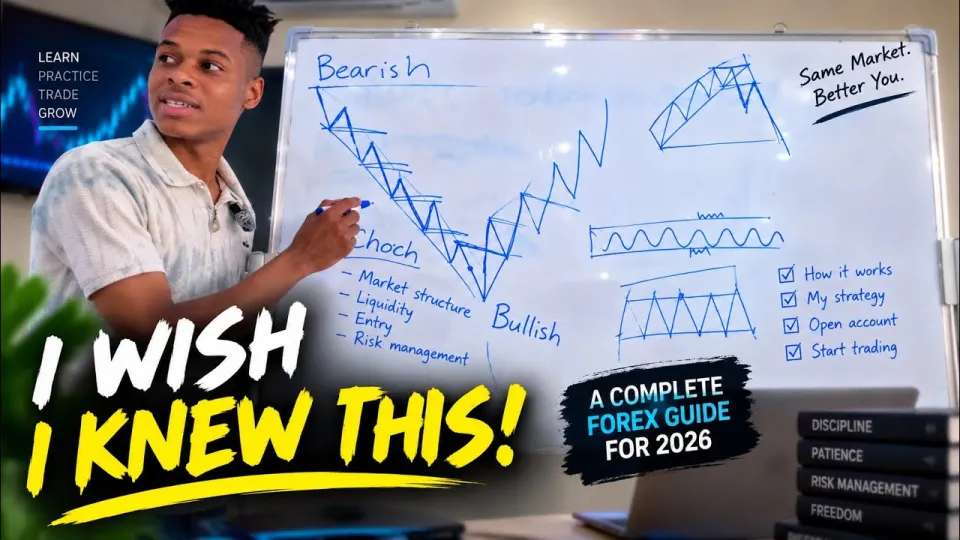
Video: How To Start Forex Trading For Beginners in 2026 (Full Guide + My Strategy)
Need articles like this for your video? They help promote it on YouTube and Google — order them in the Telegram bot @sat_sit_bot. It writes articles around your video, embeds the video and publishes them on popular niche websites (no ads). Your first 50 articles are free.
· based on the channel Carl Fx
Forex trading for beginners in 2026 comes down to three things: understanding how currency pairs are quoted and traded, opening an account with a regulated broker and practising on a demo first, then learning one repeatable chart skill — market structure — before adding any strategy or indicator. You do not need a large account or a complex system to start; you need a clear process and strict risk control. Carl Fx walks through exactly this foundation in his beginner guide, and you can open a live or demo account through the TFC Global Markets registration page he promotes in the video.
What forex trading actually is and how the market is structured
Forex is the exchange of one currency for another, and every trade is a bet on the relative strength of two economies rather than on a single asset. The market is decentralised and over-the-counter, meaning there is no single exchange; banks, funds, brokers and retail traders are connected through a network of liquidity providers. Trading runs 24 hours a day from Sunday evening to Friday evening, split into the Sydney, Tokyo, London and New York sessions.
Prices are quoted in pairs. In EUR/USD at 1.0850, the euro is the base currency and the dollar is the quote currency, so one euro buys 1.0850 dollars. A standard lot is 100,000 units of the base currency, a mini lot is 10,000 and a micro lot is 1,000. Most brokers also offer leverage, which multiplies position size against a small margin deposit — convenient, but the fastest way for a beginner to lose an account.
The pairs that matter most at the start are the majors: EUR/USD, GBP/USD, USD/JPY, USD/CHF, AUD/USD, USD/CAD and NZD/USD. They have the tightest spreads and the most liquidity, which makes them the cleanest charts to learn on.
How to open a trading account and get set up from zero
Opening an account takes minutes, but the order of the steps matters more than the speed. Work through this checklist before depositing anything:
- Choose a broker regulated by a recognised authority and check what leverage and protections apply to clients from your country.
- Complete identity verification (ID and proof of address) — this is required before withdrawals.
- Open a demo account first and treat it as a training account, not a game.
- Install a charting platform such as MetaTrader 4 or 5, or TradingView, and build a clean layout with one or two timeframes.
- Only after consistent demo results, fund a live account with money you can afford to lose.
A common stumbling block, and one that shows up repeatedly in the comments under the video, is difficulty opening the real account itself. That is usually a verification or payment-method issue rather than a trading problem — contact broker support early, and never send funds to an unverified account.
Reading bullish and bearish markets through market structure
Market structure is the sequence of swing highs and swing lows on a chart, and it tells you who is in control. In a bullish market, price prints higher highs and higher lows; in a bearish market, it prints lower highs and lower lows. A trend continues until that sequence breaks.
A break of structure happens when price closes beyond the most recent swing point against the prevailing direction — for example, a bullish market that takes out its last higher low. That break is the first warning that control is shifting, and it is the moment beginners most often misread as a fresh entry in the old direction.
Practise this on a single pair and a single timeframe, such as EUR/USD on the one-hour chart, marking every swing high and low for a few weeks. Price action reading improves through repetition on one chart far faster than by jumping between twenty instruments.
A simple beginner strategy built on price action
The strategy is deliberately plain: trade with the structure, enter on a pullback, and let the stop loss define the risk. It has four steps:
- Define the bias. Mark the recent swing highs and lows on a higher timeframe and note whether structure is bullish or bearish.
- Wait for a pullback into a zone where price previously turned — a former swing high or low, or a supply and demand area.
- Look for a confirmation candle in the direction of the bias, such as an engulfing or rejection candle at that zone.
- Place the stop loss beyond the swing that would invalidate the idea and set a target at the next structural level, aiming for at least two times the risk.
Nothing here requires indicators. The edge comes from doing the same thing repeatedly and recording the outcome of every trade in a journal: pair, session, setup type, risk, result and a screenshot. After 50 trades the journal will show which session and setup actually work for you.
Risk management rules that keep a beginner account alive
Risk control is the difference between a learning curve and a blown account. Cap risk at 1% or less of equity per trade; on a $1,000 account that is $10 of risk, which with a 20-pip stop means roughly a 0.05 lot position on EUR/USD. Ten consecutive losses at 1% cost about 9.6% of the account, which is recoverable — the same streak at 10% risk would wipe out nearly two thirds of it.
Avoid holding positions through major news releases such as central bank rate decisions and US non-farm payrolls until you understand how spreads and slippage behave. Keep a fixed maximum number of trades per day, and stop trading after a set daily loss. Leverage is a tool for sizing positions, not a target to maximise.
Common beginner mistakes and the questions traders ask most
Most beginner losses come from process failures rather than bad analysis. The recurring ones are: trading with money needed for bills, revenge trading after a loss, moving stop losses to avoid being wrong, switching strategies every week, and copying signals without understanding the setup. Another frequent trap is expecting fast results — trading is a skill built over months, not a shortcut to overnight income.
Two questions come up again and again from newer traders. The first is whether to start with a demo account; the answer is yes, and it should be used seriously, with the same position sizing and journal as a live account. The second is how to grasp the material when it feels overwhelming: reduce the scope to one pair, one timeframe and one setup, and review charts daily rather than consuming more videos. Chart examples help enormously here — study a marked-up chart of a recent setup and compare it with your own markings.
Useful links
- Open a trading account with TFC Global Markets — the broker account registration link shared in the video.
- Carl Fx free Telegram community — the channel's free trading community.
Bottom line
Forex is learnable, but only in the right order: understand the pairs and sessions, open and verify an account, spend real time on a demo, then master market structure before adding a strategy. The simple pullback-and-confirmation approach plus 1% risk per trade will not make anyone rich quickly, but it builds the discipline that separates traders who last from those who do not. This breakdown follows the beginner guide published by the Carl Fx channel, which also covers account opening and the mistakes to avoid. If you want to follow the same path, start with the TFC Global Markets sign-up page and begin on demo.
Key takeaways
- Forex is an over-the-counter market of currency pairs open 24 hours a day, five days a week, from the Sydney open on Sunday evening to the New York close on Friday.
- Beginners should spend weeks on a demo account before risking real money; a demo mirrors live pricing without financial exposure.
- Market structure — higher highs and higher lows versus lower highs and lower lows — is the first chart skill to learn before any indicator.
- A simple beginner strategy needs three parts: a bias from structure, an entry at a pullback, and a stop loss placed beyond the swing that invalidates the idea.
- Risking 1% or less of account equity per trade keeps a normal losing streak from ending an account.
Questions & answers
How much money do I need to start forex trading?
You can open many accounts with a few hundred dollars, and micro lots let you trade with tight risk on a small balance. The honest requirement is not a minimum deposit but enough capital that 1% risk per trade is a meaningful number and losing it would not affect your finances.
Should I start with a demo account or go straight to live trading?
Start on a demo and use it exactly as you would a live account, with the same position sizing and a trade journal. Move to live money only after a consistent record over dozens of trades, and fund the live account with an amount you can afford to lose.
How long does it take to become profitable in forex?
There is no fixed timeline, but most traders need many months of deliberate practice on one pair and one setup before results stabilise. Treat the first year as paid education in risk management and chart reading rather than a source of income.
Do I need indicators to trade forex?
No. Market structure and price action — swing highs, swing lows, breaks of structure and pullbacks into zones — can form a complete beginner framework on their own. Indicators can be added later, but they should confirm a decision, not replace it.
Source: How To Start Forex Trading For Beginners in 2026 (Full Guide + My Strategy) · Markdown version